The United Kingdom is the third-largest destination for students from Turkey studying abroad, after Germany and the United States. In this article, we will examine the regional and institutional preferences of students with a Turkish address, based on data from HESA (Higher Education Statistics Agency) for 2024/25. After examining the distribution of student numbers, we will analyse what these figures mean.
What Exactly Does This Data Measure?
HESA is the body responsible for compiling official statistics for all higher education institutions in the United Kingdom. An important note regarding terminology: HESA classifies international students not by their nationality, but by their permanent address at the time of their initial enrolment. Therefore, a ‘student with a Turkish address’ does not necessarily mean a Turkish national; anyone residing in Turkey who comes to the UK for education falls under this category.
In the 2024/25 academic year, the total number of students with a Turkish address was approximately 7,165. Although 205 of these were part-time students, they have been included in the full-time student count.
Regional Overview: London is the most popular
The first major finding is simple but striking: almost half of the students with a Turkish address are concentrated in a single city.
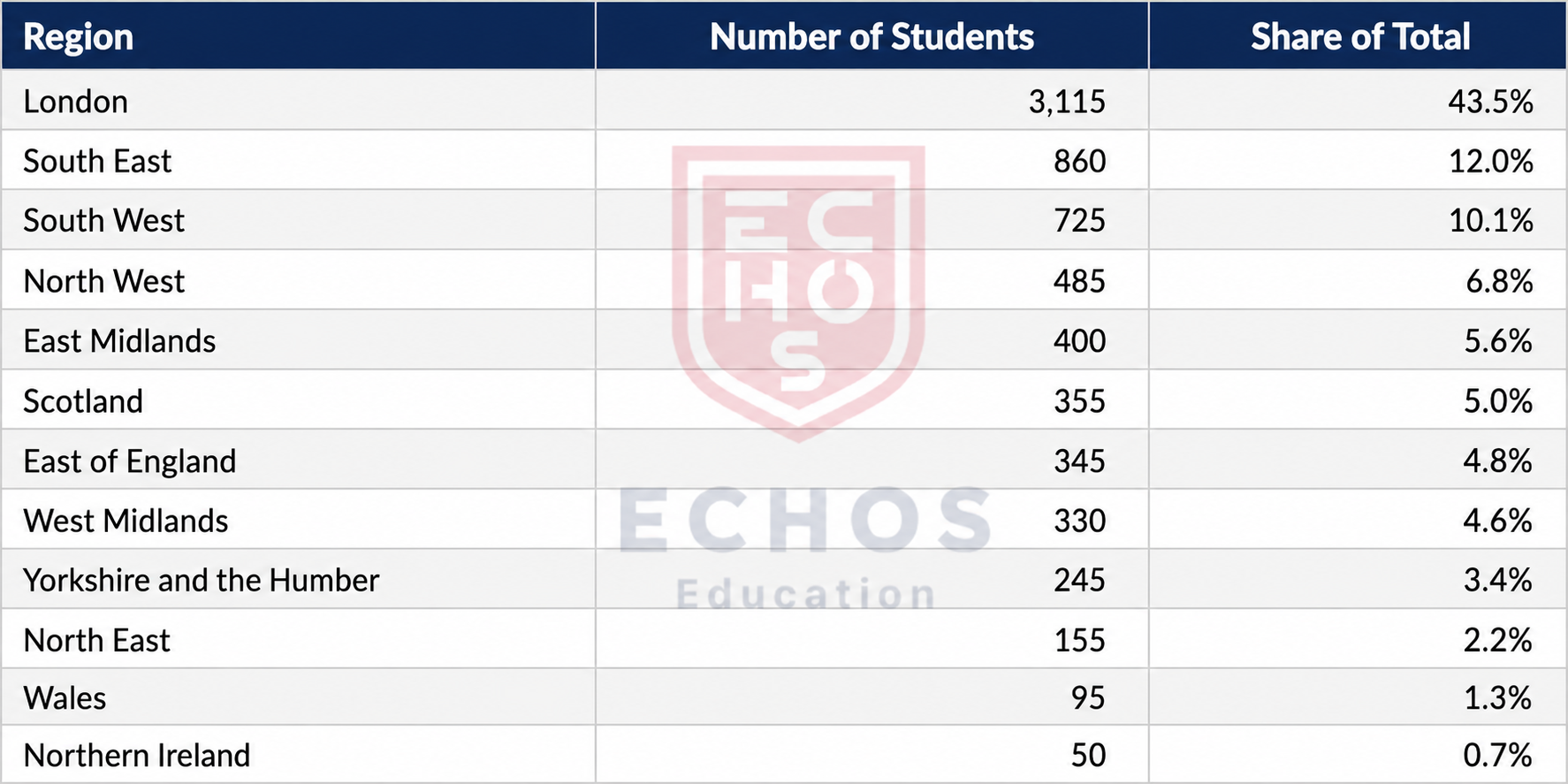
Whilst London alone accounts for 43.5 per cent of the total, when you add the South East (12 per cent) and the South West (10 per cent)—the regions closest to London—two-thirds of Turkish students are concentrated in London and the surrounding area, including Brighton. Scotland, Wales and Northern Ireland together account for just 7 per cent.
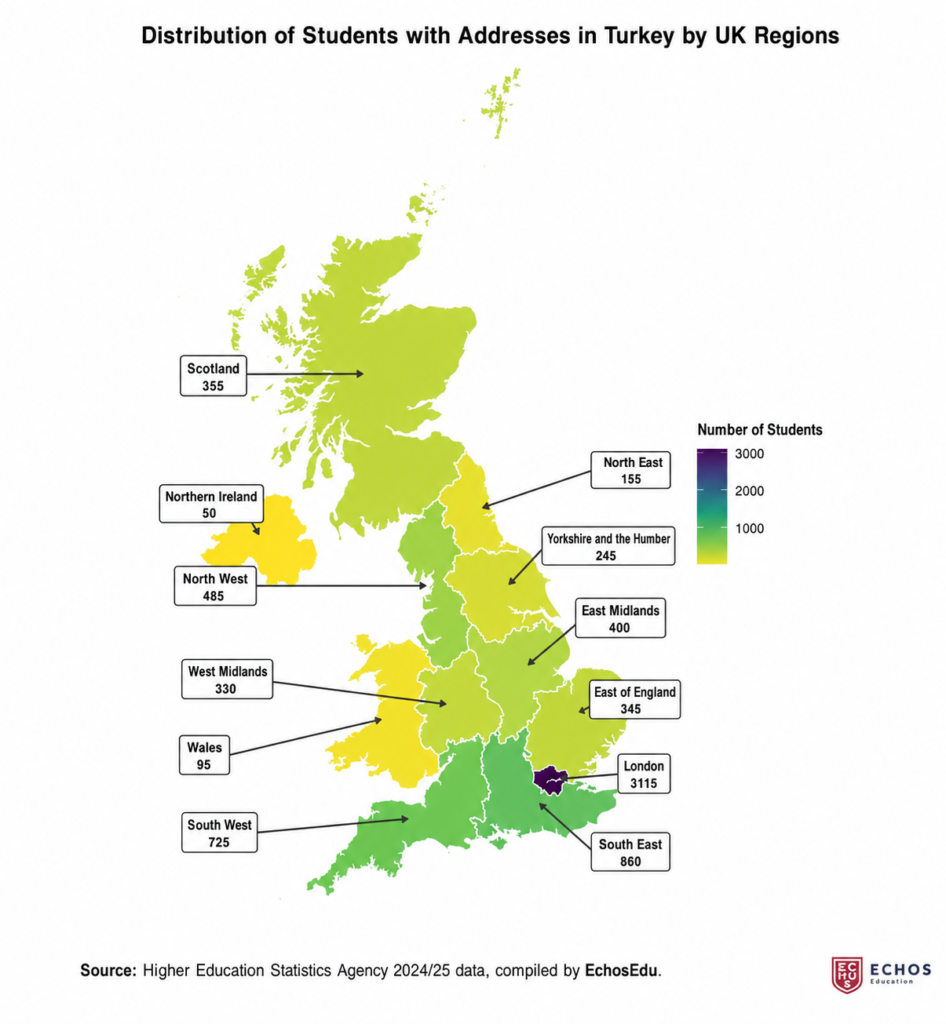
The Choice of London: Dynamics and Facts
There are many reasons for this. London is one of the cities with the highest concentration of universities. Similarly, a significant number of prestigious institutions, such as University College London, King’s College London, the London School of Economics, Imperial College London and Queen Mary University of London, are based in London. In addition, London’s robust career ecosystem in the fields of finance, law, the creative industries and technology is a major draw. Beyond academia and careers, London is perhaps the only city that offers a similar metropolitan lifestyle for students coming from major cities in Turkey.
We are frequently faced with this demand when advising the families. Sometimes, choices are made with a focus on London due to the popularity of specific schools or because someone they know is studying there. Whilst London is a city where we frequently place students, thanks to its strong academic and arts institutions, we would like to highlight a few important points.
Studying in London means having access to the academic environments of numerous universities. Students have opportunities to attend programmes and lectures at universities other than their own. However, London universities don’t have enclosed campuses. This means that students are partially deprived of campus life, which, arguably, is one of the most enjoyable aspects of the university experience that shapes their social circles. Furthermore, students from Turkey may experience delays in joining different social and professional networks due to their tendency to maintain close ties with their existing circle of friends whilst in London.
Another important point is that, unlike in Turkey, university choices in the UK are largely assessed on a department/programme basis. Academic rankings are often determined by the department rather than the university itself. Therefore, whilst taking the city or university name into account, we recommend prioritising the chosen department, the academic staff within that department, and the facilities offered.
Organisational Chart: Led by King’s College London and Queen Mary
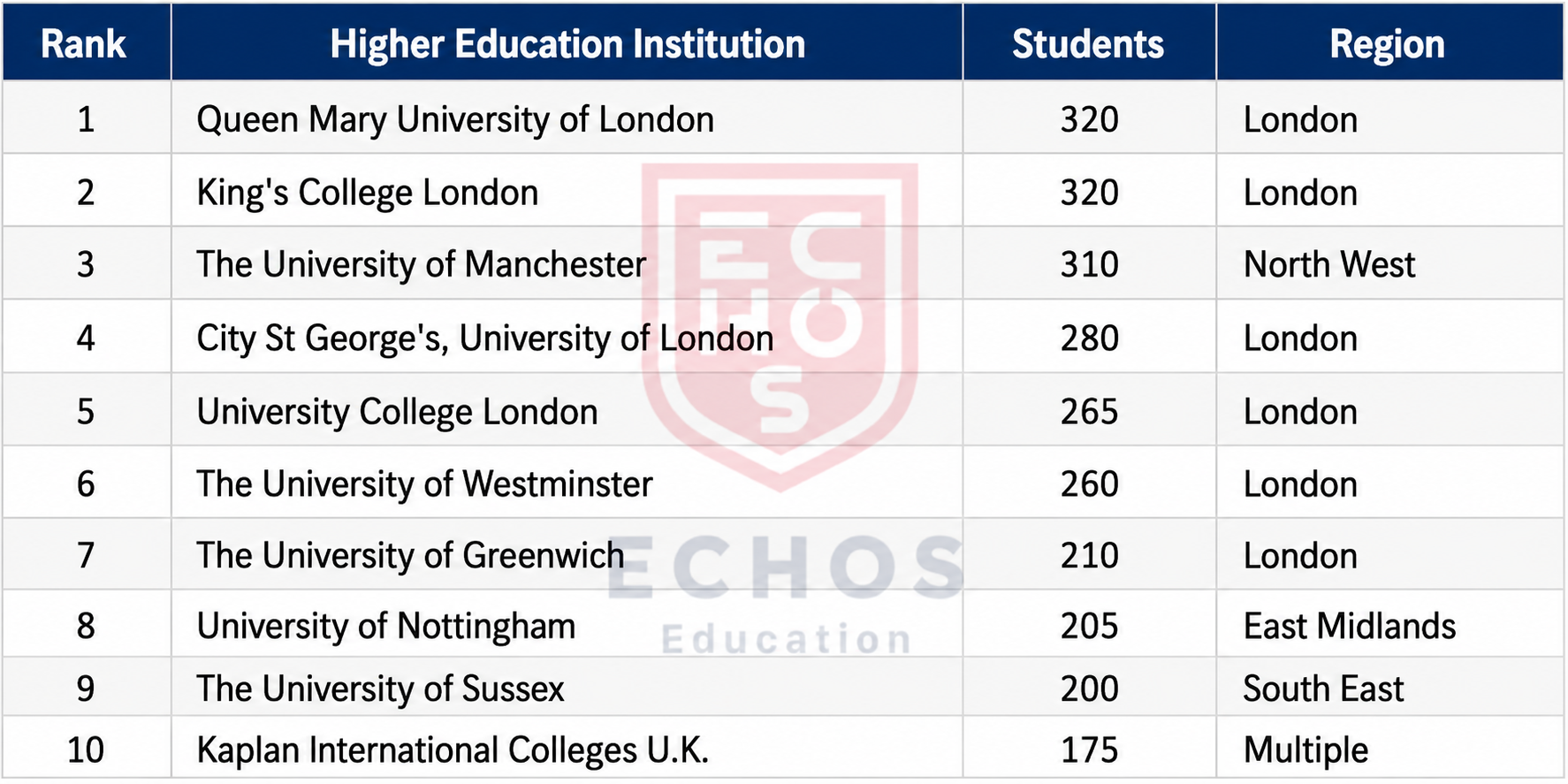
There are students with addresses in Turkey at 134 different institutions. This represents a very wide distribution. However, the distribution itself is not uniform as the top ten institutions account for approximately one-third of the total student population.
Top 10 Institutions
The Paradox of Rankings: It Is Not Prestige That Matters, but Accessibility
There are 85 students with Turkish addresses at Oxford, 50 at Cambridge, 70 at the LSE and 160 at Imperial. In contrast, there are 320 students at Queen Mary, 320 at King’s, 260 at Westminster and 210 at Greenwich. Most importantly, the flow of Turkish students is concentrated around mid-to-upper-tier Russell Group universities and London-based post-92 universities (institutions with a polytechnic background that gained university status in 1992). The most significant factor behind this distribution is how these institutions view the Turkish state secondary school diploma. Whether the admissions criteria are strict or lenient largely determines the direction of the flow of Turkish students.
Access Restrictions for G5 Universities
In this context, looking first at the G5 universities—the group of five most research-intensive and selective institutions in the UK, comprising Oxford, Cambridge, Imperial, LSE and UCL—it is evident that UCL is the only institution to feature in the top 10 of the list. Oxford (26th), Cambridge (46th), Imperial (12th) and LSE (36th) are ranked much lower on the list. The most critical factor behind this is that, in addition to their single-digit acceptance rates, the education systems from which they accept applications are quite limited. These universities do not accept direct applications from students holding a Turkish state secondary school diploma, and only consider students with A-Level, AP or IB qualifications.
The key feature that sets UCL apart from other G5 institutions is the existence of a pathway facilitating the transition from a state school leaving certificate to undergraduate study via the UCL Foundation (UPC) programme, which can be described as a kind of preparatory course. This access makes UCL relatively more accessible to Turkish students compared to other G5 institutions. According to UCL’s 2023–24 EDI Report, the student breakdown is 46% undergraduate, 38% postgraduate and 12% doctoral students, with international students accounting for approximately 53% of the total student body. This profile illustrates the extent to which the foundation pathway has become a key entry point for UCL’s undergraduate programme.
King’s and Manchester: A Channel Opened via the Foundation
The other two institutions on the list, which also feature in the world’s top 100, are King’s College London and the University of Manchester. King’s does not accept the state school leaving certificate directly; consequently, the main reason for the increase in the number of Turkish students in recent years is the expansion of foundation course places.
The situation at the University of Manchester is more nuanced. Manchester offers two pathways for holders of state secondary school diplomas: students graduating from institutions on the list of approved private schools are considered for direct entry to undergraduate programmes; those from schools not on this list, or those with insufficient grade point averages, are directed towards the foundation programme run in partnership with INTO Manchester. This structure makes Manchester one of the few universities among those ranked in the world’s top 50 that offers direct entry with a state school leaving certificate.
Post-1992 Universities: Flexible Entry, Relatively Affordable Fees
At the other end of the spectrum are the post-1992 universities. Institutions such as Westminster, Greenwich and Kingston adopt a much more flexible approach to international admissions; Turkish students can apply directly using their IELTS scores and state secondary school diplomas and grades. Part of the concentration at the top of the list is a natural consequence of this open admissions structure. In addition, tuition fees and the fact that they work with a large number of agents are factors that make these institutions attractive and visible.
The average tuition fees for the more selective Russell Group universities range from £22,000 to £28,000 for social sciences programmes and from £28,000 to £50,000 for STEM and medical programmes. At post-1992 universities, international undergraduate tuition fees typically range from £14,500 to £20,000 per year. Part of the concentration at the top of the list is a natural consequence of this open admissions structure, relatively affordable fees and high visibility through agents.
An accessibility issue is a constraint if it is identified too late; if identified early, it is a problem that can be prevented. A student’s future depends not on external factors such as admission policies, agency visibility or the availability of study pathways, but rather on their own goals, making choices that suit their academic profile, and planning their study abroad journey well in advance.
The Hidden Role of Art and Design
Further down the list is an interesting group: the University of the Arts London (170), the AA School of Architecture (75), Istituto Marangoni (70) and the Royal College of Art (15). The number of Turkish students at institutions specialising solely in art and architecture accounts for approximately 5% of the total. Furthermore, when institutions that do not technically fall into the category of art schools—despite their programmes being heavily weighted towards these fields—and the art and design departments of general universities are also taken into account, this proportion can rise to as high as 10 per cent. In other words, one in every ten students travelling from Turkey to the UK is studying art, design or architecture.
Why is long-term planning essential for art students?
This situation is of great importance for families and students planning to apply. British students who gain places on art and design courses undergo intensive art education for a total of four years during their pre-university studies—comprising two years of GCSE and two years of A-Levels—and thus begin their degree programmes with a high level of preparation. In contrast, art education in Turkey, which is often pursued merely as a hobby, can lead to significant challenges both during the application process and in terms of academic performance within the course. Consequently, for students aiming for art and design courses, long-term planning, just as in the social sciences and natural sciences, has a decisive impact on both their competitiveness in the admissions process and their subsequent academic success.
Conclusion: Looking at It from Two Perspectives
The table discussed above needs to be interpreted from two different perspectives. From the demand side, the vast majority (93%) of students from Turkey are concentrated in England across the UK, and within England, in London and the surrounding southern regions. This concentration is driven by factors such as the ease of travel from Turkey to London, the fact that a significant proportion of the most prestigious institutions are located in London, the career opportunities offered by London as a global financial and technology hub, and its cultural diversity.
From the supply side, the picture is shaped by the conditions under which institutions admit Turkish students. The fact that only UCL, among the G5 universities, features in the top 10 is due to its admission structure, which does not allow direct applications with a state secondary school diploma. On the other hand, institutions such as UCL, King’s and Manchester partially open a pathway through foundation programmes or approved school lists.
Post-92 universities in the upper echelons of the list, such as Westminster, Greenwich and Kingston, stand out for their flexible admission criteria and relatively affordable fees; meanwhile, the arts and design sectors form an unseen segment of the list, attracting approximately 10% of Turkish students.
When these two perspectives are brought together, the picture that emerges is clear: the distribution of Turkish students in the UK is neither a simple map of preferences nor a mere table of accessibility constraints. It is an outcome shaped by the intersection of the visible motivations on the demand side and the often invisible structural rules on the supply side. For a prospective student—and consequently their family—the right decision is made possible through early planning that considers both perspectives, strategically positioning the student’s goals and current academic profile within both frameworks.
Below is the full breakdown of Turkish students’ distribution across institutions in the UK, based on HESA 2024/25 data.
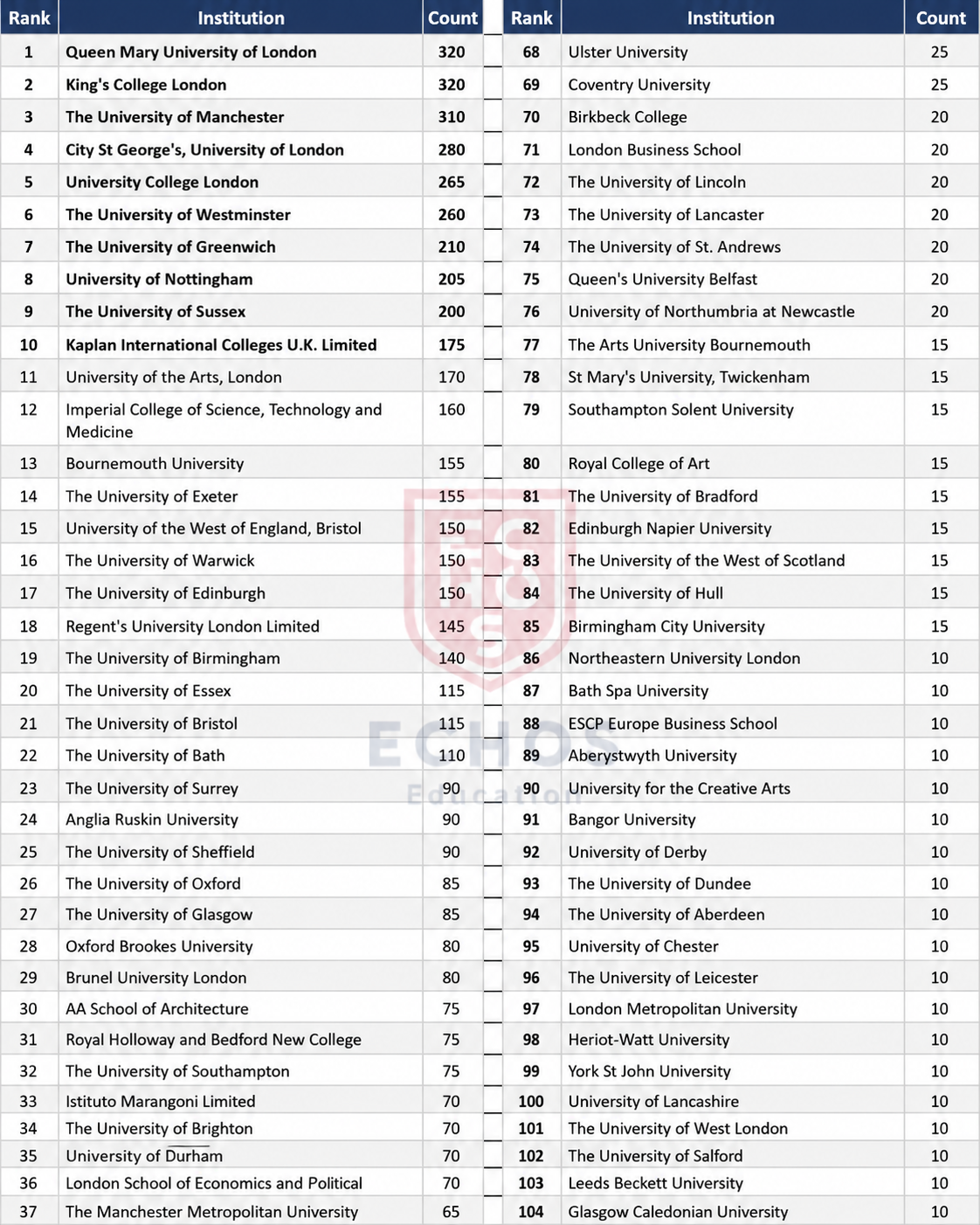
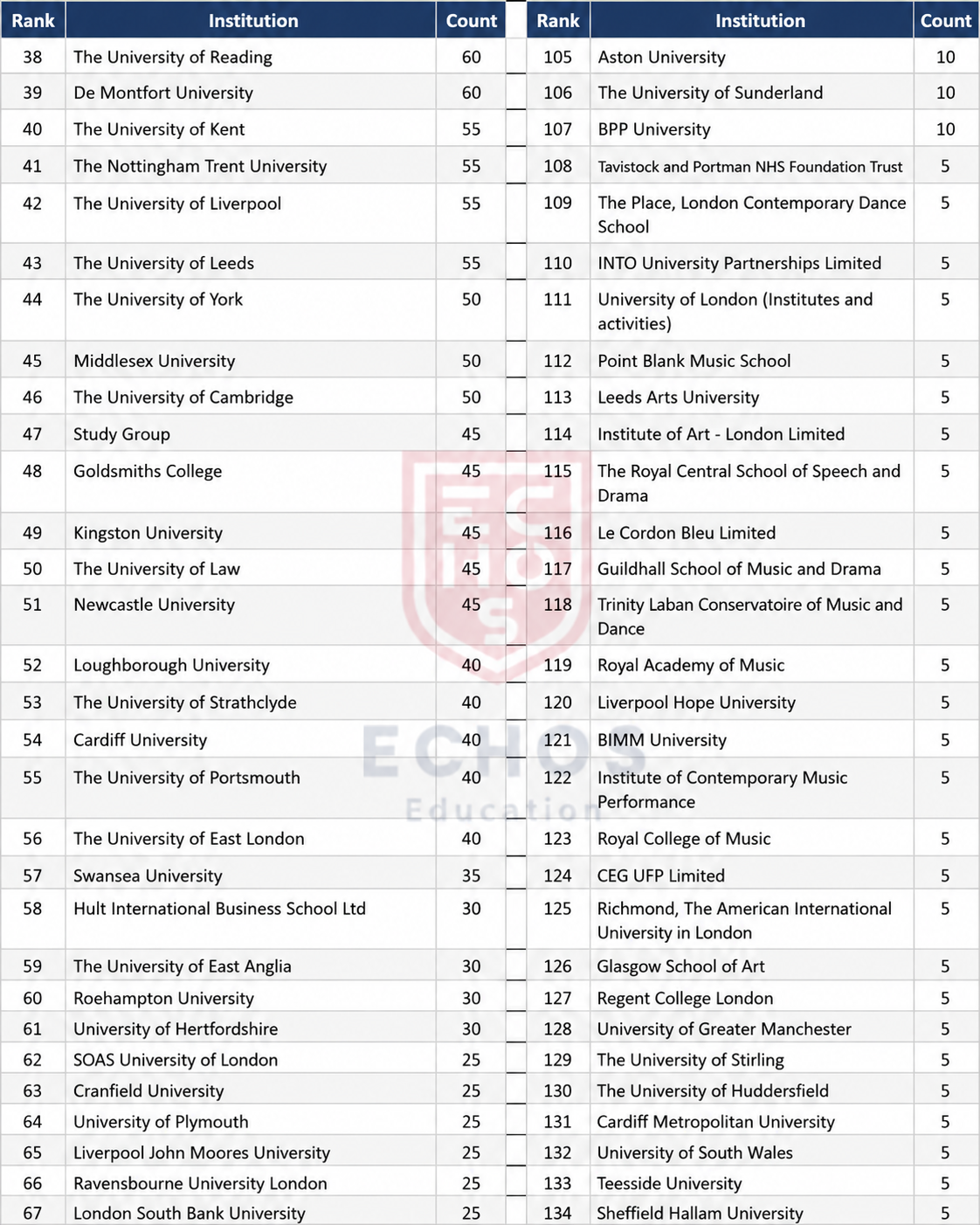
Note: A total of 205 part-time students have been counted as full-time students.