Artificial intelligence has made skill cheap. Anyone with a connection can now learn to code, write, or analyse in an afternoon. So the question worth asking about a UK degree in 2026 is not what it teaches. Almost anything can be learned for free. The question is what it certifies, and to whom that certification still means something.
Families tend to ask about visas and costs first. Those questions matter, and this article answers them with current figures. But they describe the gate, not the prize. The prize is a world-class education set inside an environment that does something a classroom cannot: it teaches a student to run their own life, and it hands them a qualification the world still trusts. This article covers what a UK degree offers, the facts to plan around, and the one factor that decides the outcome. That factor is not money or visa status. It is what the student does with the freedom they are given.
What a UK Education Actually Offers
The UK’s universities are globally respected for a reason. The teaching is rigorous, the institutions are old and serious, and the qualifications carry weight worldwide. That much is well known.
Less well understood is how UK study works day to day, and why it matters more than the syllabus. UK higher education is built on self-direction. Contact hours are relatively light. Nobody checks whether a student has done the reading. Nobody chases missed work. The structure assumes that a student will manage their own time, set their own pace, and take responsibility for their own progress.
To a family used to closely supervised schooling, this can look like a lack of support. It is the opposite. A student learns to plan, to prioritise, to work without being told, and to recover when something goes wrong. These are not study skills but life skills, and they transfer directly into work and adulthood. The degree certifies knowledge. The experience of earning it certifies that the person can operate on their own, and the wider world values the second thing at least as much as the first.
This is why a UK degree prepares a student for life and not only for a profession. Everything is, in a word, self. Self-study, self-management, self-improvement. The student who understands this early treats the years as training in autonomy, not as a series of deadlines to survive.
An Environment That Makes Independence Possible
Independence on its own can be isolating, especially for someone far from home. What makes the UK unusual is that the environment actively supports the student who is learning to stand on their own feet.
The country is genuinely international. UK higher education enrolled about 686,000 international students in 2024/25, drawn from across the world (HESA, 2026). A newcomer from abroad is not an outsider here. They are part of the majority, and that changes everything about settling in. The social fabric is built to absorb people from elsewhere.
The culture is also, in daily terms, kind and open. Asking for help is normal and usually met with patience. Writing to an academic, a society, or an event organiser is accepted practice and is often answered. Beyond the university itself, the UK has an exceptional density of professional bodies, learned societies, public lectures, libraries, and museums, most of which welcome students at little or no cost. A first-year can attend a public talk at a major institution, ask a question, and be taken seriously.
Put the two together and the picture is clear. The UK gives a student the freedom to direct their own life, and surrounds them with a community that makes that freedom workable and even enjoyable. The student improves themselves, but they do not have to do it alone.
The Practical Facts: Visas
Two facts need honest planning, and the first is the visa. The Student visa is the main entry route, with a fee of £558 (Home Office, 2026a). One of the things that makes the UK attractive is what comes after the degree: graduates are allowed to stay and work without needing an employer to sponsor them straight away. This is the Graduate Route, and it currently gives bachelor’s and master’s graduates two years, and doctoral graduates three (UKCISA, 2025). It is a genuine head start, and it is worth knowing that the window is being shortened. For applications made on or after 1 January 2027, it drops to 18 months for non-PhD graduates, while PhD graduates keep three years (UKCISA, 2025).
To stay longer, most graduates move to the Skilled Worker visa, which needs a licensed sponsor and a qualifying salary. From July 2025, the general threshold is £41,700 or the going rate for the role, whichever is higher, with a lower entry point of around £33,400 for new entrants and recent graduates in degree-level roles (Home Office, 2026b). First-time applicants from January 2026 also need B2 level English (Home Office, 2026b).
None of this is a wall. It is a filter. The graduate who has used their time well, and who has built something worth sponsoring, clears it. The point of planning is to be that graduate before the window closes.
The Practical Facts: Cost and City
The second fact is cost, and here families differ, so the right approach is to understand the range and choose deliberately. Average student living costs run about £1,142 per month nationally, exceeding £1,000 in almost every region and running several hundred pounds a month higher in London, typically £300 to £500 above most other cities (Save the Student, 2026). For a family for whom cost is not the binding factor, London is an excellent choice: it has the deepest concentration of universities, employers, and events in the country, and the premium buys genuine access.
For a family that wants strong value, the smarter move is often a city within one to two hours of London. Reading is about thirty minutes by rail, Brighton, Oxford, and Cambridge roughly an hour, Bath and Bristol under two. Coach travel keeps the distance cheap: National Express runs Bristol to London up to 34 times a day from under £7 one-way (National Express, 2026), so a student can attend London events regularly while paying far less rent. It is the same calculation a company makes when choosing an office. Lower cost is worth taking only when it does not cut off access, and from these cities it does not.
On accommodation, there are three common paths. University halls are simplest for a first year, usually with bills included. A shared house is the cheapest per person and builds a ready social circle. A private studio offers the most privacy at the highest cost. Most students search on Rightmove and SpareRoom, and full-time students are exempt from council tax (GOV.UK, 2026). Booking early secures both price and choice.
The Job Market, and Why The Educated Still Win
The graduate job market has tightened, and this should be stated plainly. Total UK vacancies fell to 711,000 in early 2026, the lowest since 2021, and graduate-specific vacancies dropped around 35 percent year on year (Office for National Statistics, 2026; Adzuna, 2026). Entry-level roles have been hit hardest (Institute for Employment Studies, 2026).
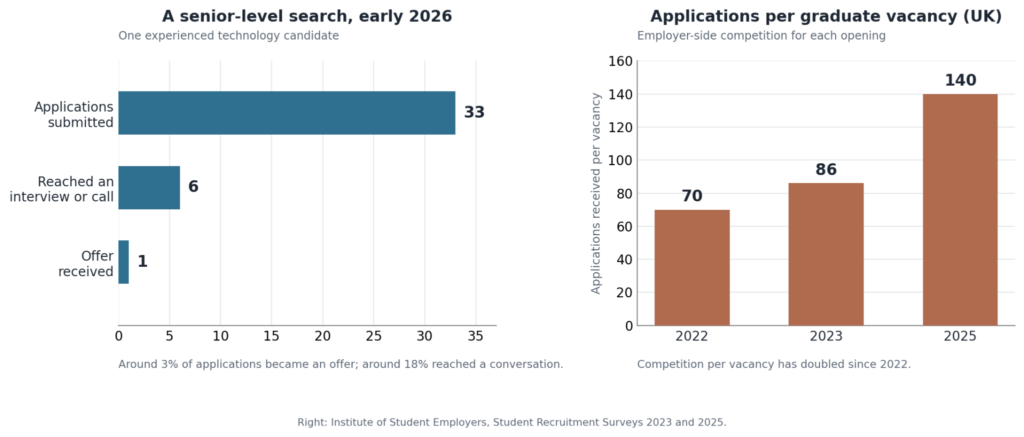
The two panels measure different things and should not be read as the same number. The left tracks one experienced candidate’s funnel: how many applications turned into conversations and an offer. The right shows employer-side competition: how many applications each graduate vacancy now attracts.
The two pictures tell one story. On the left is a single senior-level search in early 2026, run by an experienced candidate with strong credentials. It took 33 applications to reach one offer, and only about a fifth of applications led to any kind of conversation. If the odds are that demanding for an experienced applicant, a graduate should plan for a longer search, not a shorter one. On the right is the wider picture from employers who run formal graduate schemes. The number of applications competing for each such vacancy has roughly doubled since 2022, reaching about 140 per opening (Institute of Student Employers, 2025). Part of that rise is driven by AI tools that let candidates apply at scale, which makes a strong, verifiable application matter more, not less.
This is the part that frightens families, so it is worth putting in proportion. The world has not stopped needing capable people. It has become more selective about who counts as one. Every developed economy runs on knowledge, and governments and companies still compete hard for capable graduates. The question is no longer whether educated people are wanted, but whether a given graduate is one of them.
That is decided by what the student builds, not by the certificate alone. Specific tools and technical knowledge are increasingly common and therefore cheap. What stays valuable is the ability to see a problem, think it through, deliver a solution, and explain it, exactly the capacity the UK’s self-directed system builds. The market is harder, but it rewards the qualities a UK education is designed to produce.
This points back to where the article started, and to the single most important thing for families to understand. When skill is abundant, skill stops being the scarce thing. What becomes scarce is trust. An employer, a client, or a government needs to know that a person’s ability is real, that their work holds up, and that their qualification means what it claims. That assurance is what accreditation provides: a credible third party vouching that the standard was met. Skill can now be downloaded. Trust still has to be earned.
This is where the UK holds an advantage that is hard to replicate. It is one of the world’s centres of accreditation. Its universities, degrees, and professional bodies are trusted internationally, the product of institutions that have held their standards for a long time. A UK degree is not a receipt for what you learned. It is a signal, recognised across borders, that you can be trusted to deliver. When anyone can acquire the skill, the proof that you can be trusted to use it is what opens the door, and the UK remains one of the best places in the world to earn that proof.
What Decides The Outcome
So the visa is a fact, and cost is a fact. Neither decides the outcome that matters, by which most families mean two things: finishing the degree, and turning it into work, whether a sponsored job in the UK or a strong start to a career anywhere. The deciding factor in both is the student.
The UK hands a student an unusual amount of freedom and a rich environment, then largely steps back. The one who treats that freedom as licence to drift will struggle anywhere. The one who treats it as raw material for self-improvement, who studies on their own initiative, joins the communities open to them, builds visible work, and reaches out to people, becomes the kind of graduate every employer and every government still wants.
Practically, three habits compound over a degree. Build visible proof of work, through projects, writing, or contributions that exist outside the CV. Join the relevant professional institution as a student member, since the UK’s chartered bodies across engineering, computing, science, and other fields recognise and welcome students. And use the events, contributing rather than only attending. None of this requires wealth. All of it requires initiative.
Conclusion
Studying in the UK in 2026 comes with real constraints. Visa routes are narrower than they were and the cost of living asks for deliberate choices. These deserve honest planning, and this article has set out the figures to plan with.
But the constraints are the gate, not the prize. The prize is a world-class education delivered inside one of the most open and welcoming environments anywhere, an environment that teaches a young person to run their own life. That is a training for life, not only for a career.
The visa and the cost are decided by policy. The outcome is decided by the student. Skill is now cheap and trust is scarce, and a UK education still offers both halves of what a career needs: the training that builds a capable person, and the accreditation that proves it to the world. For the student who takes the freedom seriously and uses it to grow, the UK still opens the doors it always has.
Hüseyin Berkay Yıldırım Biography
Berkay Yildirim is an AI and Cloud Engineer based in London. With 10 years of experience across AI, software engineering, and cloud architecture, he has delivered production systems spanning finance, biotechnology, telecommunications, and construction, working with international teams across the USA, UK, Canada, and Europe.
He holds an MSc in Artificial Intelligence from the University of the West of England, where his research focused on making medical AI transparent and explainable for clinical decision-making. He was invited to present his research on Sovereign AI at the Alan Turing Institute International Conference on Trustworthy Digital Infrastructure, held at the Royal Institution of Great Britain, with work published by the Institution of Engineering and Technology.
Berkay is a Member of the IET (MIET), AWS Certified Solutions Architect, and IET Career Mentor.
References
Adzuna. (2026, April 30). UK job market report (April 2026 edition). Retrieved May 2026, from https://www.adzuna.co.uk/job-market-report/
GOV.UK. (2026). Council tax: Discounts for full-time students. https://www.gov.uk/council-tax/discounts-for-full-time-students
HESA. (2026). Higher education student statistics: Where students come from and go to study. Higher Education Statistics Agency. https://www.hesa.ac.uk/data-and-analysis/students
Home Office. (2026a). Student visa. GOV.UK. https://www.gov.uk/student-visa
Home Office. (2026b). Skilled Worker visa (see “Your job” and “When you can be paid less” for salary rates). GOV.UK. https://www.gov.uk/skilled-worker-visa
Institute for Employment Studies. (2026). A perfect storm for graduates. https://www.employment-studies.co.uk/
Institute of Student Employers. (2025). Student recruitment survey 2025: Trends, benchmarks and insights. https://ise.org.uk/
National Express. (2026). Coach Bristol to London: Timetables and fares. https://www.nationalexpress.com/en/destinations/london/bristol-to-london
Office for National Statistics. (2026). Vacancies and jobs in the UK. https://www.ons.gov.uk/employmentandlabourmarket/peopleinwork/employmentandemployeetypes
Save the Student. (2026). National Student Money Survey 2026 and University student statistics. https://www.savethestudent.org/money/surveys/UKCISA. (2025). Student update: Changes to the Student and Graduate Rules. UK Council for International Student Affairs. https://www.ukcisa.org.uk/news/student-update-changes-to-the-student-and-graduate-rules/