The recent changes in the number of Turkish students choosing to pursue higher education abroad remains a popular topic of discussion on social media.
What do the existing figures say on this matter? Our team has taken a close look at the possible reasons.
Firstly, it should be noted that it is virtually impossible to determine how many students go to study abroad. This is because students wishing to study in a foreign university are not required to obtain permission from, or provide information to any official authority in Turkey. As a result, we do not have any national statistics on this matter, leaving us only with a rough estimate of the exact number.
However, countries can and do keep a record of their international students. For example, information such as the country of origin of international students coming to Turkey is recorded by higher education institutions. These records are compiled by the Council of Higher Education (YÖK) and the Turkish Statistical Institute (TÜİK), and are shared with the public and international authorities. Similarly, other countries also keep records of the students who come to study there.
In theory we may be able to gauge the number of students leaving Turkey from the statistics of the countries they are heading to. However, it is difficult to access the statistics of each country individually. While it is arguably easier to access data from states that are members of the United Nations, the figures from different countries are often not comparable.
Before discussing the figures regarding the number of higher education students leaving Turkey to study abroad, we must pay attention to the statistical definitions used by the UNESCO Institute for Statistics. The Institute for Statistics, affiliated with the United Nations Educational, Scientific and Cultural Organisation (UNESCO), is the official and reliable source for internationally comparable statistics in the fields of education, science and culture. The Institute refers to students going abroad or international students as “internationally mobile students”. It defines these students as follows: “Internationally mobile students are individuals who physically cross a country’s border to participate in educational activities in another country; here, the student’s country of origin and the country of destination are different.”
According to this definition, the most important factor in determining whether a higher education student is internationally mobile is whether they are pursuing higher education in a country physically distinct from the country in which they obtained their secondary education (country of origin).
When determining the country of origin, the country in which the student completed their secondary education is taken as the basis, rather than their country of residence or citizenship. Similarly, any transition from secondary school to university that does not involve physically crossing international borders is not considered international student mobility. Consequently, distance learning programmes are not assessed within the context of international student mobility.
The data presented in the graph is based on the above definition of international student mobility by the UNESCO Institute for Statistics and has been compiled from data provided by participating countries. The graph below illustrates the change in the number of students leaving Turkey for study abroad between 2004 and 2023.
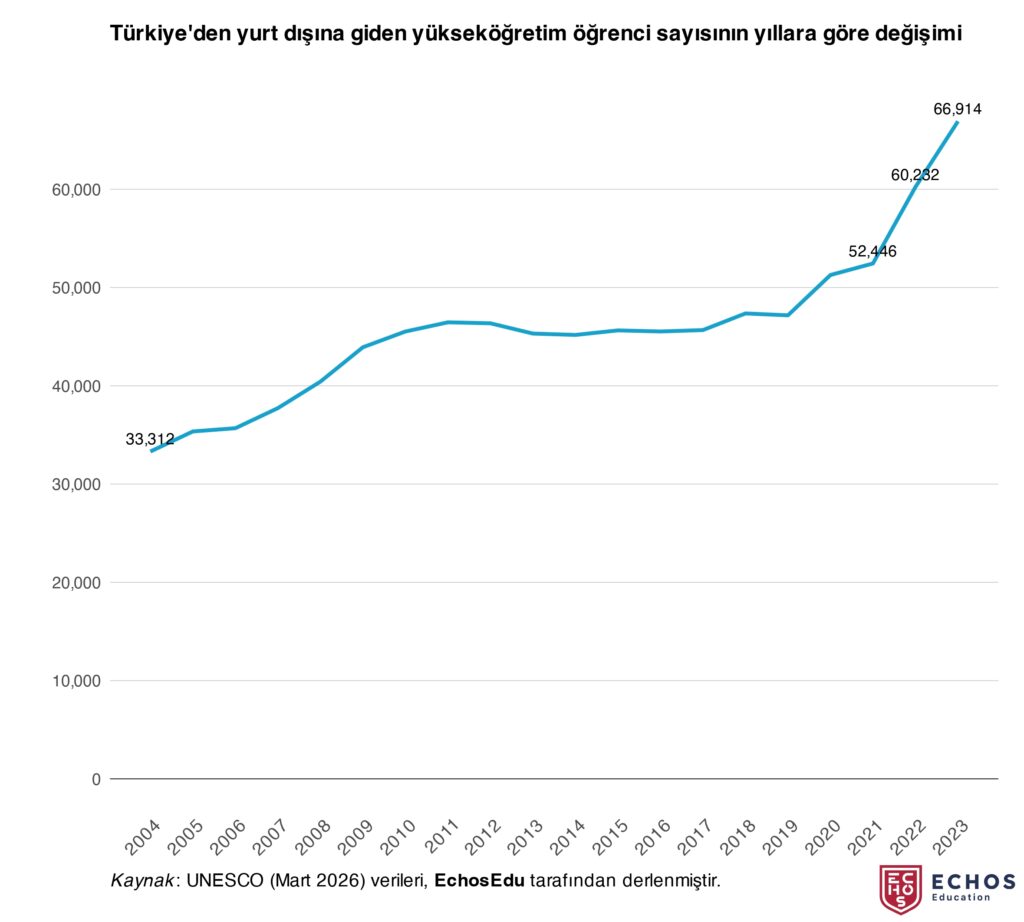
The key figures highlighted in the graph can be summarised as follows:
*The number of students from Turkey studying abroad, which stood at 33,000 in 2004, reached 67,000 in 2023. This indicates that student mobility abroad doubled during this period.
*The 20-year period can be roughly divided into three phases. In the first phase, spanning 2004–2011, the number of students increased steadily. In the second phase, spanning 2012–2019, the number of students remained relatively stagnant. The period from 2020 onwards, however, indicates a phase of rapid growth. It is evident that international student mobility, which had slowed during the pandemic, has continued to gain momentum in the post-pandemic period.
*A growth of over 10 per cent is notable between 2021 and 2022, and between 2022 and 2023. Of course, comprehensive research is required to determine the reasons behind this growth.
In summary, UNESCO data indicates that the number of higher education students leaving Turkey for study abroad continues to rise rapidly. International student mobility is the result of a highly complex interplay between pull factors, which may include quality of education and economic and social opportunities in the destination country, as well as the push factors, such as economic hardship and social conflict in the country of origin. However, whatever the possible reasons may be, the increase in student mobility worldwide is quite striking. If the current trend continues, we can safely say that student mobility from Turkey to other countries will see a larger increase in the coming years.